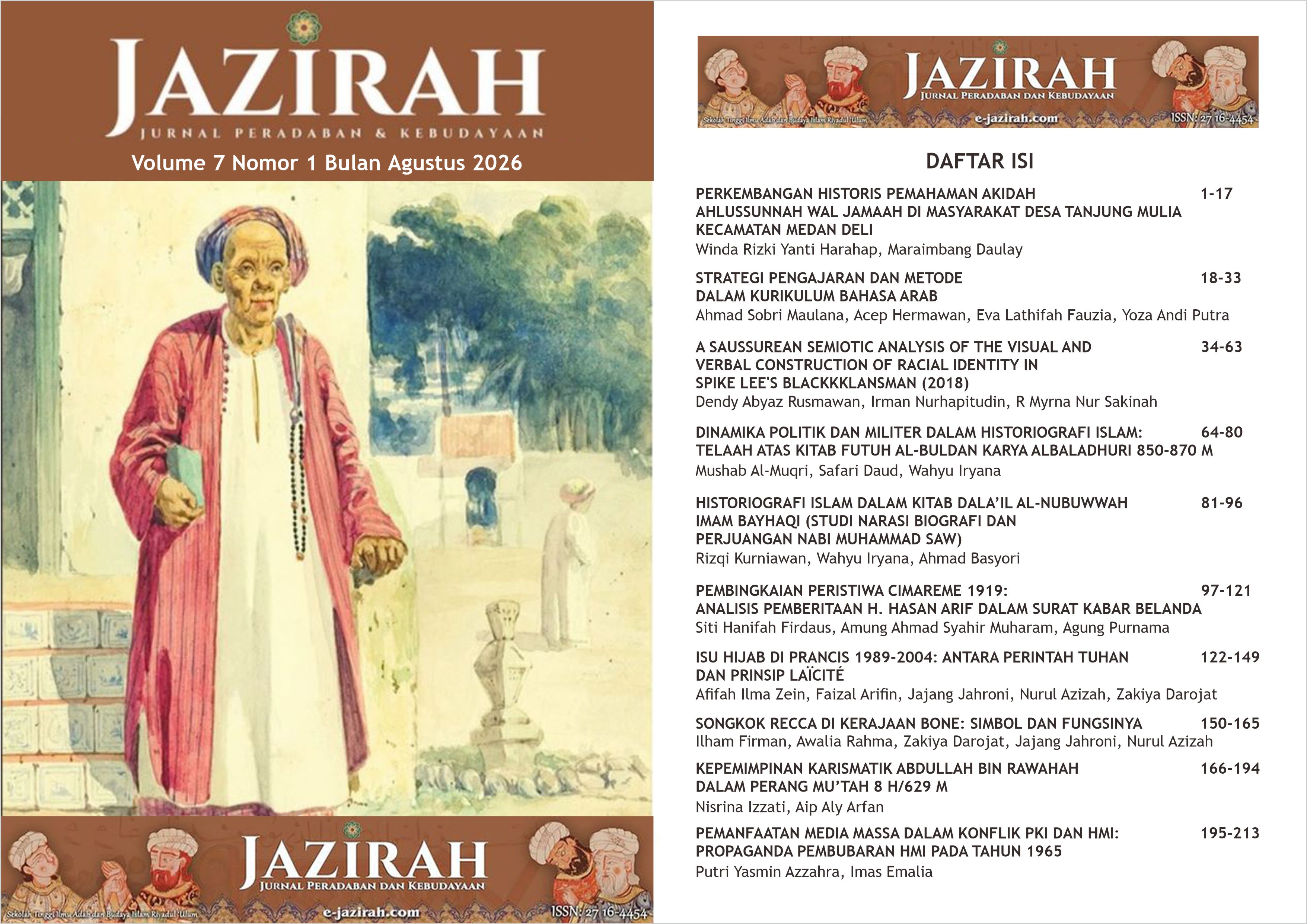
ISU HIJAB DI PRANCIS 1989-2004: ANTARA PERINTAH TUHAN DAN PRINSIP LAÏCITÉ
Article Sidebar
Main Article Content
Abstract
This study examines the development of the hijab issue in French public schools between 1989 and 2004, beginning with the Affaire du Foulard at Collège Gabriel-Havez in Creil and culminating in the enactment of Loi n° 2004-228 du 15 mars 2004. Unlike previous studies that primarily focus on state policy, legal aspects, or intellectual debates, this research traces the evolution of the hijab controversy through the experiences of Muslim schoolgirls, school-level policy dynamics, and changes in state policy during the period. The study employs a social history approach using the historical method, consisting of heuristics, source criticism, interpretation, and historiography. The sources include audiovisual archives from the Institut National de l'Audiovisuel (INA), contemporary media reports—particularly Le Monde—legal documents, and relevant scholarly works. The findings reveal four main points. First, Muslim schoolgirls understood the hijab as an integral part of their religious identity, whereas school authorities interpreted it within the framework of laïcité. Second, between 1989 and 1992, the controversy was addressed through dialogue, negotiation, and differing interpretations at the school level, resulting in diverse experiences among Muslim schoolgirls. Third, following the issuance of the Circulaire Bayrou in 1994 and the establishment of the Stasi Commission in 2003, the debate gradually shifted from school-based disputes to a broader national discussion concerning laïcité, integration, and republican identity. Fourth, the enactment of Loi n° 2004-228 du 15 mars 2004 replaced case-by-case resolutions at the school level with a uniform national legal framework, affecting both educational opportunities and the ways in which Muslim schoolgirls maintained their religious identity. This study argues that the development of the hijab issue in France cannot be understood solely through changes in state policy but must also be examined through the experiences of Muslim schoolgirls, whose voices constitute an essential part of the history of the French hijab controversy.
Downloads
Article Details

Authors who publish with this journal agree to the following terms:
- Copyright on any article is retained by the author(s).
- The author grants the journal, right of first publication with the work simultaneously licensed under a Creative Commons Attribution License that allows others to share the work with an acknowledgment of the work’s authorship and initial publication in this journal.
- Authors are able to enter into separate, additional contractual arrangements for the non-exclusive distribution of the journal’s published version of the work (e.g., post it to an institutional repository or publish it in a book), with an acknowledgment of its initial publication in this journal.
- Authors are permitted and encouraged to post their work online (e.g., in institutional repositories or on their website) prior to and during the submission process, as it can lead to productive exchanges, as well as earlier and greater citation of published work.
- The article and any associated published material is distributed under the Creative Commons Attribution-ShareAlike 4.0 International License